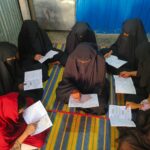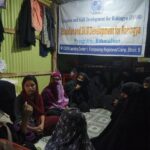
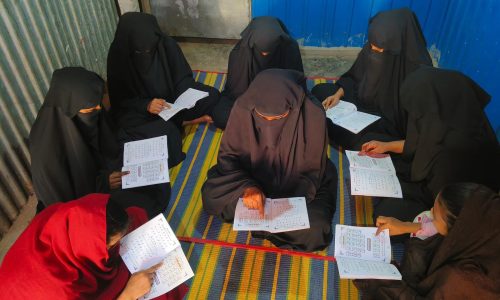
At ESDR’s learning center, 13-year-old Kohinur Akter carefully traces letters in the Rohingya Hanifi script. Though she is a school-going student, this is the first time she has learned to read and write her own native language. Like nearly all Rohingya children, Kohinur grew up speaking and understanding Rohingya fluently—but without access to literacy in her mother tongue.
Kohinur is a student of ESDR’s Rohingya Language and Literacy Initiative, a program created to address a long-standing gap in Rohingya education. While she attends regular school classes in other languages, it was only at ESDR that she learned to read and write Rohingya in script.
Kohinur’s story is deeply rooted in displacement. Her mother fled Myanmar in 1994 and took refuge in Cox’s Bazar, Bangladesh. Kohinur herself was born in Kutupalong Refugee Camp, where generations of Rohingya have grown up without formal access to education in their own language.
Language is more than communication—it is identity, emotion, and belonging. Yet when Rohingya children begin their education, they are required to study in foreign languages such as English or Burmese, which are difficult for many to understand and remember. This language barrier slows learning, creates confusion, and often leads to frustration and dropout.
Although the Rohingya Hanifi script was developed in 1982 by Maulana Hanif and his team, it remained largely inaccessible for decades. Only about 0.05% of Rohingya people were familiar with the written language. It was not until around 2012 that the script slowly began reaching refugee camps in Bangladesh, and even then, only a small number of people had the opportunity to learn it.
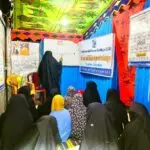
Recognizing this urgent need, ESDR founded the Rohingya Language and Literacy Initiative to ensure children—especially girls—could reconnect with their mother tongue. At ESDR’s learning center, Kohinur studied under a trained Rohingya female teacher, in a safe, friendly, and supportive environment where girls feel comfortable learning.
After just three months of study, Kohinur can now confidently read and write in Rohingya Hanifi script. More importantly, she has become a young advocate for language preservation. She now teaches Rohingya reading and writing to her friends, sisters, and neighbors—passing on knowledge that was once denied to her community.
“I couldn’t read or write my native language before,” Kohinur says. “Now, after studying at ESDR, I can read and write it well—and I can teach others too.”
She adds, “If we can study in our native language, learning becomes much easier for us.”
Kohinur’s journey reflects the powerful impact of ESDR’s work. By restoring access to the Rohingya language, ESDR is not only preserving a culture—it is strengthening confidence, improving learning outcomes, and empowering a new generation to carry their identity forward with pride.